A Playground Accident That Looked Minor
The boy, a 9-year-old, was playing on a seesaw in his neighborhood when the child at the other end pushed sharply upward. His abdomen slammed into the metal crossbar in front of the seat.
He climbed down at once, doubled over and clutching his stomach. The pain was intense and he could not straighten up. His parents sensed immediately that something was wrong, and rushed him to Beijing Jingdu Children's Hospital.
Why a Blow to the Belly Can Be So Dangerous
An impact to the abdomen without an open wound is called blunt abdominal trauma. In children it is one of the most easily underestimated injuries, because the skin often looks completely normal while the damage is happening deep inside.
The abdomen holds organs that are soft, rich in blood, or filled with digestive fluid. A blow can bruise or tear the liver and spleen, or crush a loop of intestine against the spine. A child's abdominal wall is thinner and the rib cage offers less protection than an adult's, so the same impact can do more harm.
This is why doctors treat abdominal pain after an accident as a possible emergency — even when there is nothing to see on the outside.
The Warning Signs — and the Tests That Confirmed the Diagnosis
At the hospital, the Pediatric Surgery team moved quickly. The boy's symptoms pointed to a serious internal injury: severe abdominal pain, an inability to stand up straight, and marked tenderness when his belly was examined.
Two imaging tests confirmed the diagnosis:
- Abdominal ultrasound showed fluid collecting inside the abdomen — a sign that something had leaked or bled.
- An upright abdominal X-ray revealed free gas under the diaphragm. This is the classic signature of a perforated digestive tract: air that should stay sealed inside the intestine has escaped into the abdominal cavity.
A blood test added one more clue. The white blood cell and neutrophil counts were both markedly elevated, showing that the body had already begun to fight an infection.
Taken together, these findings pointed to a single conclusion: a perforation of the digestive tract, which required emergency surgery.
Emergency Surgery: Why the Location Matters
After a full discussion with the family and their consent, Dr. Liu Wei, Director of Pediatric Surgery, led the team into the operating room.
Dr. Liu Wei explains that in cases like this, the surgical plan depends entirely on where the perforation is:
- Colon (large intestine): Because the colon contains large amounts of bacteria and stool, a one-stage repair is usually unsafe. Surgeons create a temporary stoma, bringing the two ends of the bowel out through the abdominal wall, and close it after 3 to 6 months.
- Small intestine: A one-stage repair, called a primary anastomosis, is usually possible.
- Duodenum: If the injury is higher up and involves the duodenum, it may also affect the bile duct, making the operation more complex.
When Dr. Liu Wei opened the abdomen, he found a large amount of yellow-green fluid — intestinal contents mixed with digestive juices that had severely contaminated the abdominal cavity. Inflammation had caused the loops of small intestine to stick together. Careful exploration revealed the source: a hole about 2 centimeters in diameter in the jejunum, with swollen and congested edges. The diagnosis was confirmed — a jejunal perforation.
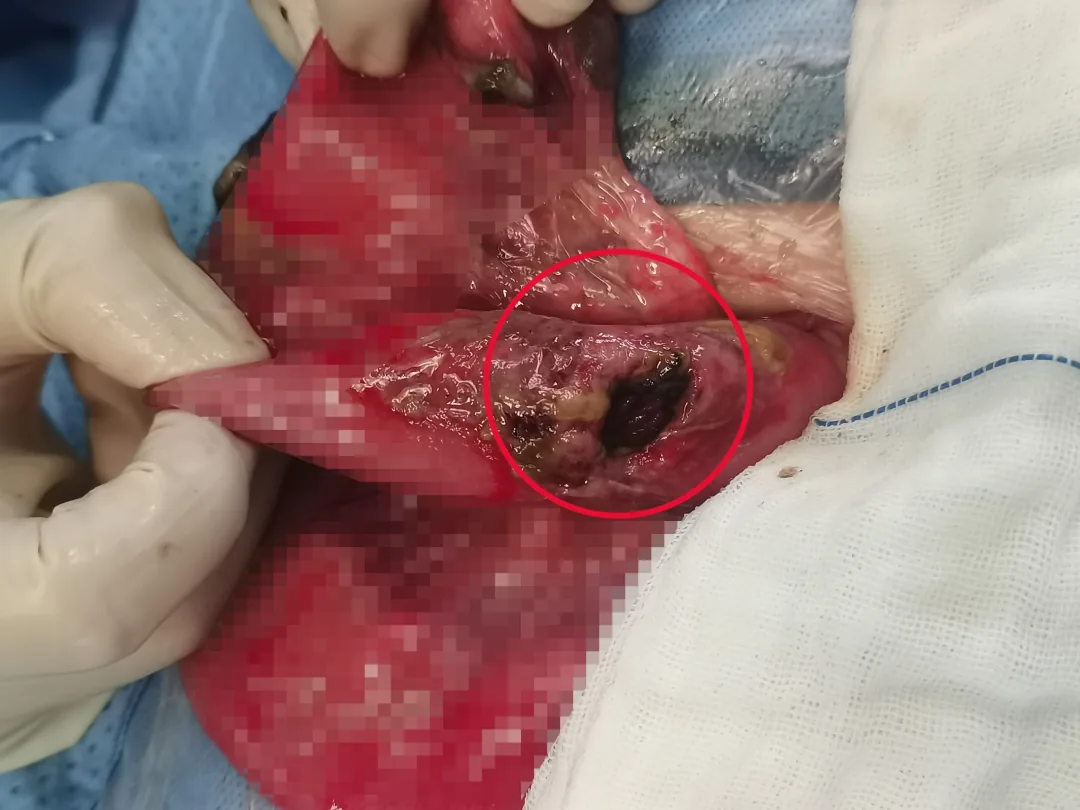
During surgery, a perforation about 2 cm in diameter was found in the jejunum.
Repairing the Perforation
Dr. Liu Wei removed the ruptured segment of bowel and rejoined the two healthy ends with an end-to-end anastomosis. The operation went smoothly.
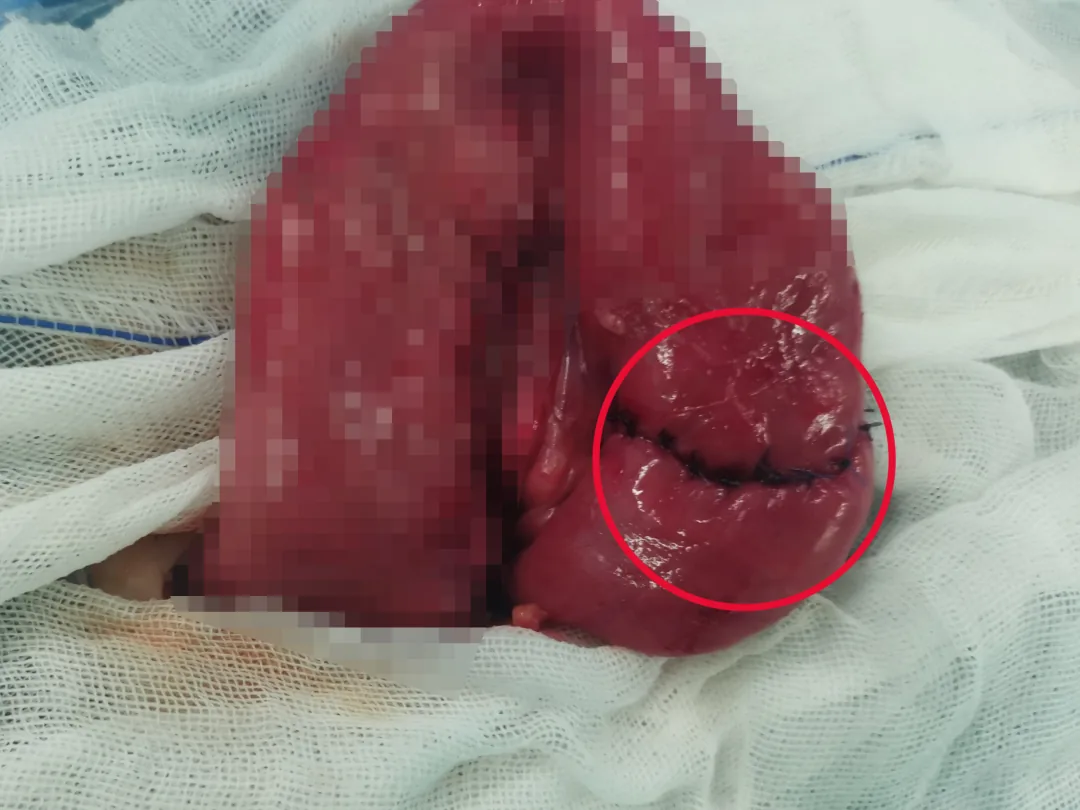
After the ruptured segment was removed, the bowel was rejoined with an end-to-end anastomosis.
The Two Challenges After Surgery
Successful surgery was only the first step. Two hurdles still lay ahead:
- Infection: Because the abdominal cavity had been heavily contaminated by intestinal fluid, there was a high risk of post-operative infection. The team watched closely and treated it with antibiotics.
- Nutrition: After a bowel anastomosis, a child cannot eat normally for a short period. Nutrition must be delivered intravenously — enough not only to meet daily metabolic needs, but also to provide the extra protein the healing bowel requires.
A Full Recovery
With careful treatment and nursing from the Pediatric Surgery team, the boy passed through the critical period safely. One week after surgery he was already up and active again. He has since recovered fully and gone home.
What Every Parent Should Know
Blunt abdominal trauma is a common childhood injury. Seesaws, bicycle handlebars, and the corners of tables are frequent causes. After a blow to the belly, a child may have no visible wound at all and still be seriously injured inside.
When to Seek Emergency Care
Take your child to hospital immediately if, after an impact, they have severe abdominal pain, pain that makes them bend over and unable to stand straight, vomiting, a belly that is swollen or tender to the touch, or increasing drowsiness and paleness. Do not wait to see whether the pain passes on its own.
About the Pediatric Surgery Team
Dr. Liu Wei
Director, Pediatric Surgery, Beijing Jingdu Children's Hospital
Dr. Liu Wei led the emergency surgical team in this case. He emphasizes that after blunt abdominal trauma in a child, rapid assessment and prompt surgery are essential, and that the exact location of a digestive-tract perforation determines whether a one-stage repair or a staged procedure is needed.
The Pediatric Surgery Department at Beijing Jingdu Children's Hospital provides emergency and planned surgical care for infants, children, and adolescents, working closely with anesthesiology, imaging, and intensive care teams to treat traumatic injuries and other surgical conditions.
← Back to News