About the 2026 EHA Annual Meeting
The 31st European Hematology Association (EHA) Annual Meeting was held in Stockholm, Sweden from June 11–14, 2026, in a hybrid format combining in-person and online participation. The congress brought together leading hematologists and researchers from around the world to discuss the pathogenesis, precision diagnostics, cutting-edge therapies, and patient management in blood disorders.
Invited by the scientific committee, Dr. Xiao Juan (Director) and Dr. Chen Jiao (Director) from Prof. Sun Yuan's team presented their research as poster presentations, delivering the "Jingdu Voice" of Chinese pediatric hematology to the world.
Prof. Sun Yuan's team at the 31st EHA Annual Meeting, Stockholm, June 2026
Poster 1: HSCT for CNS-HLH in Children
Allogeneic Hematopoietic Stem Cell Transplantation in Primary Hemophagocytic Lymphohistiocytosis with Central Nervous System Involvement in Children
Juan Xiao, Shifen Fan, Zhouyang Liu, Fan Jiang, Jiao Chen, Yuan Sun*
Department of Hematology, Beijing Jingdu Children's Hospital, Beijing, China
Background
Primary hemophagocytic lymphohistiocytosis (PHLH) is a life-threatening immune disorder. When the central nervous system (CNS) is involved (CNS-HLH), the prognosis is particularly poor, and data on transplant outcomes in this subgroup are limited.
Methods
A retrospective analysis was performed on 74 pediatric patients with PHLH who underwent allogeneic HSCT at Beijing Jingdu Children's Hospital between January 2018 and June 2025. Of these, 18 had CNS involvement.
Key Findings
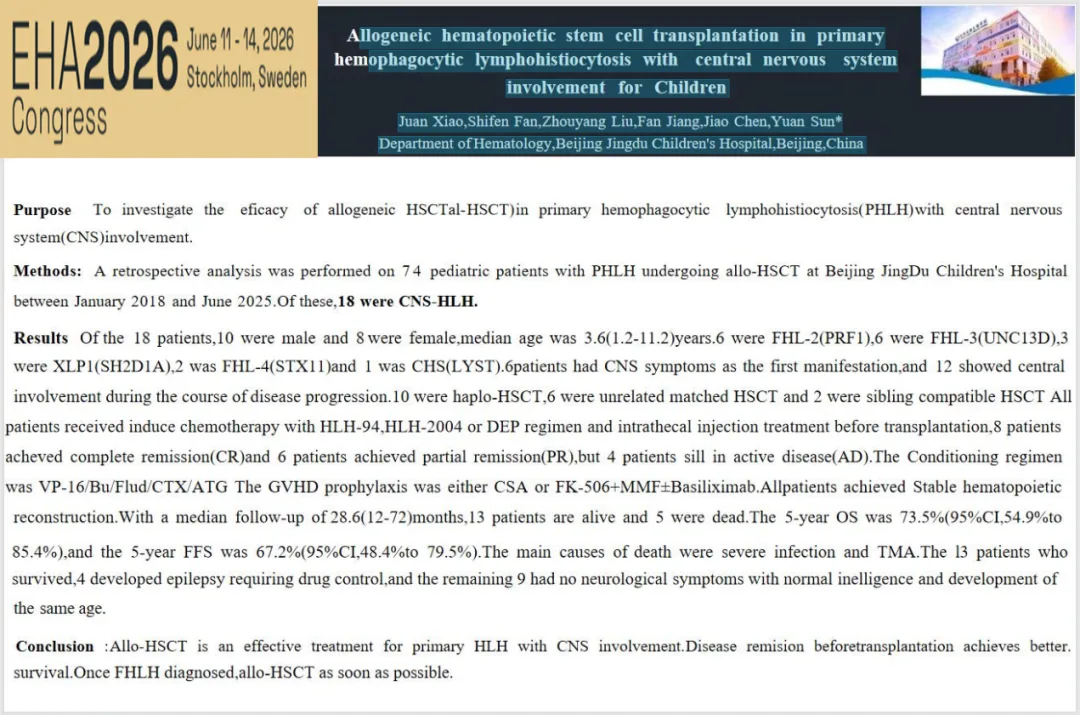
Poster: Allogeneic HSCT in primary HLH with CNS involvement — EHA 2026, Stockholm
- Gene mutations: FHL-2 (PRF1) n=6, FHL-3 (UNC13D) n=6, XLP1 (SH2D1A) n=3, FHL-4 (STX11) n=2, CHS (LYST) n=1
- Transplant types: Haploidentical HSCT n=10, Unrelated donor HSCT n=6, Sibling-matched HSCT n=2
- Pre-transplant status: Complete remission (CR) n=8, Partial remission (PR) n=6, Active disease (AD) n=4
- Conditioning: VP-16 / Busulfan / Fludarabine / Cyclophosphamide / ATG
Outcomes
Poster 2: HSCT for Shwachman-Diamond Syndrome (SDS) — 116 Cases
Clinical Characteristics and Hematopoietic Stem Cell Transplantation Prognosis in Shwachman-Diamond Syndrome: A Report of 116 Cases from a Single Chinese Center
Jiao Chen, Zhouyang Liu, Zhende Hou, Xiaoda Li, Shifen Fan, Fan Jiang, Yuan Sun*
Beijing Jingdu Children's Hospital, Beijing, China
Background
Shwachman-Diamond syndrome (SDS) is a rare inherited bone marrow failure syndrome characterized by pancreatic exocrine insufficiency, bone marrow dysfunction, and skeletal abnormalities. Severe cases can progress to myelodysplastic syndrome (MDS) or acute myeloid leukemia (AML). This study represents the largest single-center case series of SDS transplant outcomes reported internationally to date.
Patient Cohort (N=116)
Key Clinical Findings
- Genetic mutations: SBDS compound heterozygous n=92, SBDS homozygous n=23, EFL1 compound heterozygous n=1
- Chronic diarrhea: 86.2%
- Cytopenia: 97.4%
- Liver dysfunction: 86.2%
- Neurological abnormalities: 50%
- Dental abnormalities: 41.4%
- Skeletal abnormalities: 37.9%
- Cardiac abnormalities: 36.0%
- Progressed to AML: 1 case (0.9%); progressed to MDS: 11 cases (9.5%)
Transplant Outcomes (28 Transplanted Patients)
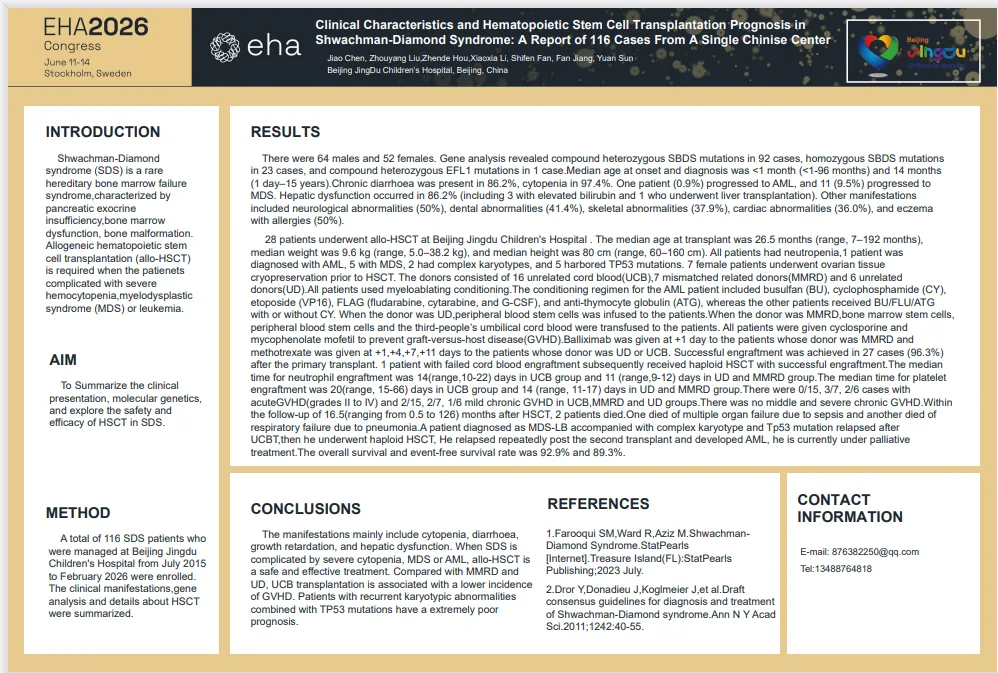
Poster: Clinical Characteristics and HSCT Prognosis in Shwachman-Diamond Syndrome — 116 Cases — EHA 2026, Stockholm
- Donor sources: Unrelated cord blood (UCB) n=16, Mismatched related donor (MMRD) n=7, Unrelated donor (UD) n=6
- Engraftment success: 27/28 (96.3%) after primary transplant; 1 UCB failure salvaged by haploidentical HSCT
- Neutrophil engraftment: UCB group median 14 days; UD/MMRD group median 11 days
- Acute GVHD (grade II–IV): UCB 0/15, MMRD 3/7, UD 2/6
- Chronic GVHD: No moderate or severe cases in any group
- Ovarian tissue cryopreservation: performed in 7 female patients prior to HSCT
Impact & Significance
These two presentations represent important contributions from China to the global pediatric hematology community:
- The CNS-HLH study provides the first systematic analysis of HSCT outcomes in this high-risk subgroup, offering evidence-based guidance for international clinical practice.
- The SDS study is the largest single-center transplant case series ever reported for this ultra-rare disease, providing invaluable real-world data for global rare disease management.
- Both studies showcase the clinical excellence and research capabilities of Prof. Sun Yuan's team at Beijing Jingdu Children's Hospital, Asia's largest pediatric HSCT center.
About the Hematology & Oncology Center
Under the leadership of Prof. Sun Yuan (President of Beijing Jingdu Children's Hospital), the Hematology & Oncology Center has completed nearly 1,000 hematopoietic stem cell transplants, covering PHLH, Shwachman-Diamond syndrome, primary immunodeficiency diseases, and thalassemia. Multiple research achievements have been presented at top international academic conferences including ASH and EHA.
← Back to News