Just past midnight on Ward 8 of the Hematology-Oncology Department, the lights at the nurses' station were still on. A little girl, not yet three, toddled over, tilted her head up, grinned at the nurse on duty — and then, without a word, began to dance.
She said nothing. She did not need to. Every doctor and nurse watching understood. She was saying thank you.
Her name is Guoguo (pseudonym), and she comes from Pakistan. She has laughing eyes and reaches up to be held by anyone who passes. Everyone on the ward knows her.
But only a few months earlier, this smiling little girl was carrying a heavy chain: beta-thalassemia major.
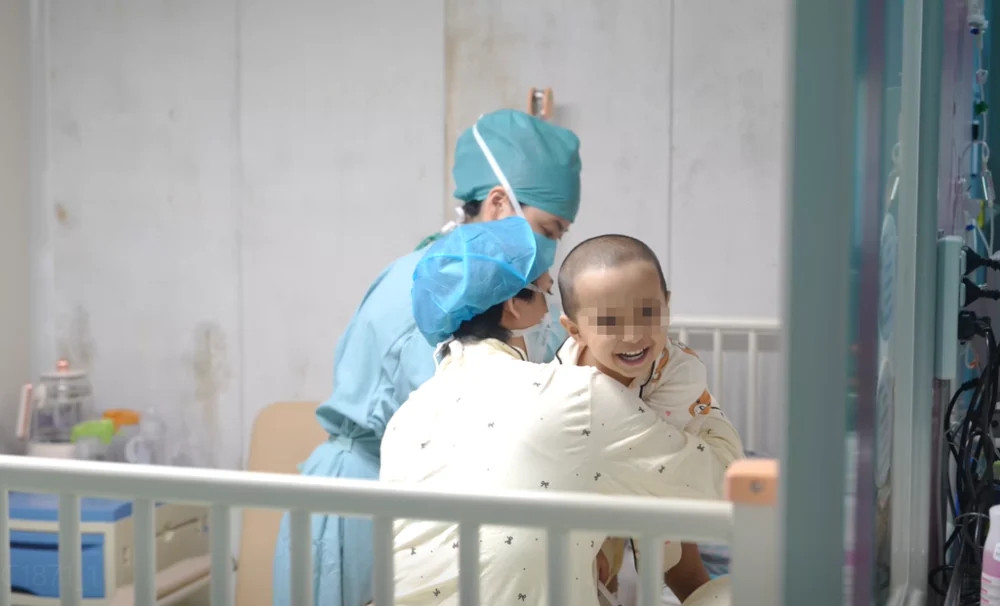
Guoguo inside the transplant unit — a place she turned, as much as anyone could let her, into a playground
A Test Paper With No Answer Key
Guoguo is her parents' first child. From the day she was diagnosed with beta-thalassemia major, regular blood transfusions became part of her life.
Transfusions sustain a child. They do not cure one. Blood carries iron, and the body has no natural way to shed the excess. Month by month, iron settles into the liver, the bones, the heart, the endocrine organs — doing damage that no one can see from the outside.
For children like Guoguo, hematopoietic stem cell transplantation (HSCT) is at present the most important way to resolve the underlying disease and give her a chance at long-term survival.
Her father works in Australia. The family had lived there, and they had also returned to China seeking treatment. Wherever they went, the answers rhymed:
- Both parents are carriers of the thalassemia gene.
- Guoguo has no fully HLA-matched sibling — so a matched-sibling transplant was out of reach.
- In Australia, the waiting time was too long, and the cost beyond what the family could bear.
- In Pakistan, there was no better option available locally.
For a long stretch, the family felt like students staring at an exam paper with no answer key — writing down the same question, over and over, and getting nothing back.
Just as they were almost ready to give up, Beijing Jingdu Children's Hospital came into view. In the end, the family fixed their eyes on Beijing.
Two Paths, One Long Decision
After half a year of correspondence, the family finally landed in Beijing on June 24, 2026.
Following admission, Prof. Sun Yuan (President) and Dr. Liu Zhouyang (Director) led the hematology team through a comprehensive assessment. The world marrow donor registry returned no suitable unrelated donor. A fully matched sibling was never an option. The team sat down with the parents, again and again, and laid out two roads:
One: have a healthy child through assisted reproduction, then use that baby's cord blood for a matched-sibling transplant. This route carries the lowest risk of graft-versus-host disease and rests on well-established experience — but it takes time: stimulation, pregnancy, delivery, and no guarantee that a matched unit will result.
Two: use her father as the donor and perform a haploidentical (half-matched) transplant. A parent is always available, and the transplant can proceed within weeks. The trade-off is a higher risk of graft-versus-host disease and a more demanding recovery.
"Neither road is easy. One asks for time. The other asks for courage."
Guoguo's parents thought about it for a long, long time. In the end, they chose the haploidentical transplant from her father.
Why a Parent Can Almost Always Donate
A child inherits one set of HLA genes from each parent, so a mother or father is always at least half-matched. This is what "haploidentical" means. That single biological fact means a child is essentially never without a donor. At Jingdu, haploidentical HSCT is the backbone of the pediatric transplant programme, and it is why families arrive here after being told elsewhere that no donor could be found.
Dr. Jiang Fan became Guoguo's attending physician. From her very first day on the ward, Dr. Jiang acquired a small shadow. Guoguo spoke no Chinese, so Dr. Jiang chatted with her in English words and through a translation app on her phone. On rounds, Guoguo would grin at her and hold up her arms to be picked up.
"She isn't shy at all — she smiles at everyone," Dr. Jiang said. "Every time I see that smile, I feel that no amount of tiredness matters."
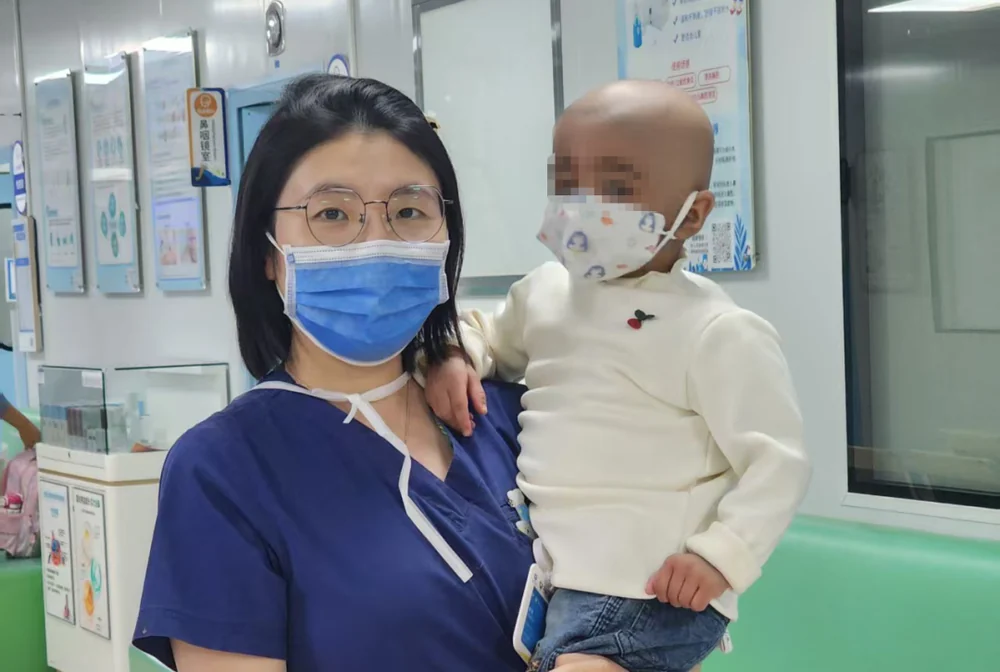
Guoguo being carried by Dr. Jiang Fan — language was never the barrier it looked like
The Night Owl of the Transplant Unit
The transplant date was set. Before she entered the unit, infection precautions were not yet at their strictest, and Guoguo was often allowed out to wander. The whole ward became her playground.
She could not speak the language, yet with a translation app and an unstoppable smile she became someone everyone knew. The nurses' station, the doctors' office, the far end of the corridor — each of them holds the memory of a small, unsteady figure toddling past.
What left the nurses both laughing and helpless was her schedule. At eleven or twelve at night she was still wide awake. The moment her mother looked away, she would slip out to the nurses' station and dance for whichever nurse was on night duty — small arms lifted, a little wiggle, eyes curved into crescents. Whatever sleepiness the nurses had been fighting simply evaporated.
By morning she could not be woken at all, wrapped up in her blanket and dead to the world. Her mother shook her head. Her father laughed.
"For that stretch of time, she was our little sunshine. When you saw her, the air on the ward felt lighter."
Behind that lightness was a much heavier kind of vigilance. Prof. Sun Yuan and Dr. Liu Zhouyang convened discussions time and again, adjusting the plan to her responses. Dr. Jiang Fan recorded every small change each day. The nursing team worked around the clock, making every detail as safe as it could possibly be.
The transplant went more smoothly than anyone had dared to expect. No infection. No rejection. Her small body accepted her father's hematopoietic stem cells, and held on to them.
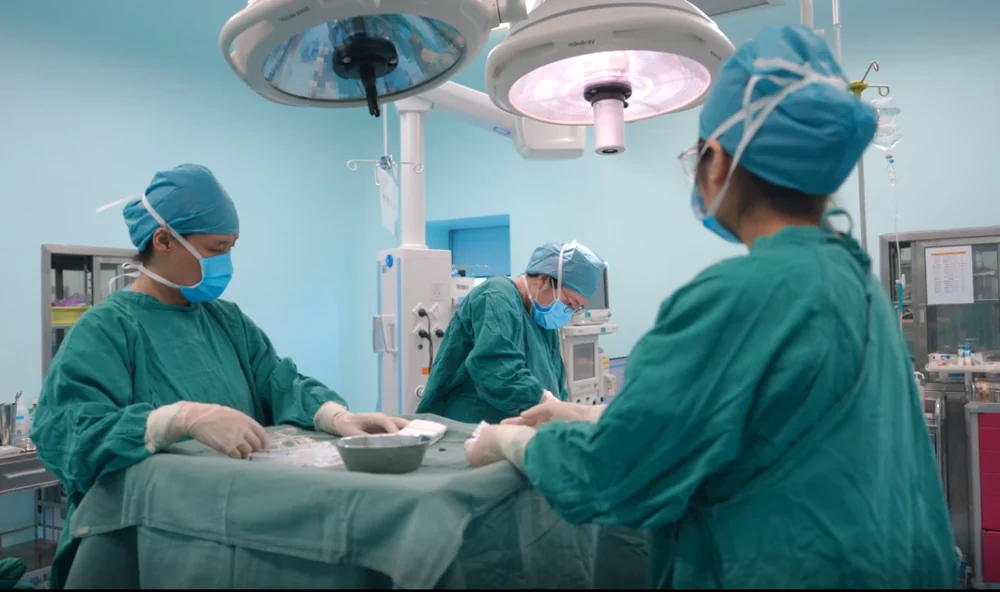
Before the transplant, Dr. Jiang Fan collected peripheral blood stem cells from Guoguo's father — the first half of a life given twice
Beyond the Limits of Medicine
Today, Guoguo is approaching three months post-transplant. This week she will undergo her three-month comprehensive review. If everything is stable, she will fly home with her mother and father.
But as departure gets closer, the doctors and nurses have started to feel the loss. "Soon no one will come and dance for us at midnight."
Her father says that once she is well, they will take her back to Australia and live quietly as a family.
He also says he will never forget Beijing — never forget the place that let Guoguo run again, and dance again.
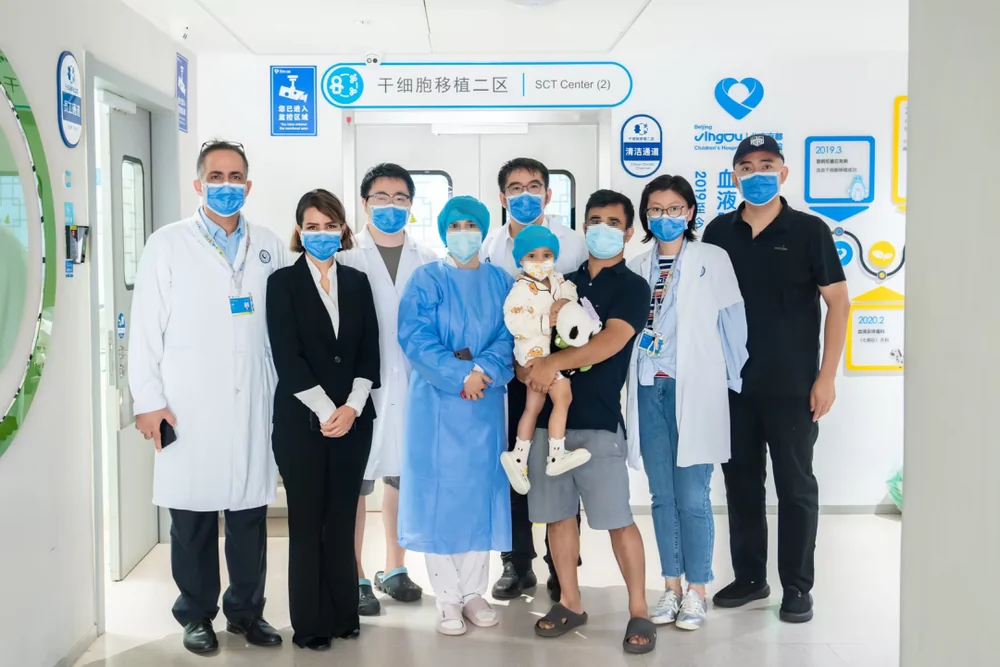
Transplant successful, Guoguo out of the unit — the team that kept watch, and the family that kept faith
To a child of three, none of this has a name. She does not know what "engraftment" means, or "discharge after recovery." She only knows that the people here smile at her, so she dances for them.
The adults know what that midnight dance really carried: a family's journey across three countries; a medical team's day-and-night watch; a little girl not yet three, turning fear and pain into joy in the most innocent way available to her.
Medicine has its limits. Compassion does not.
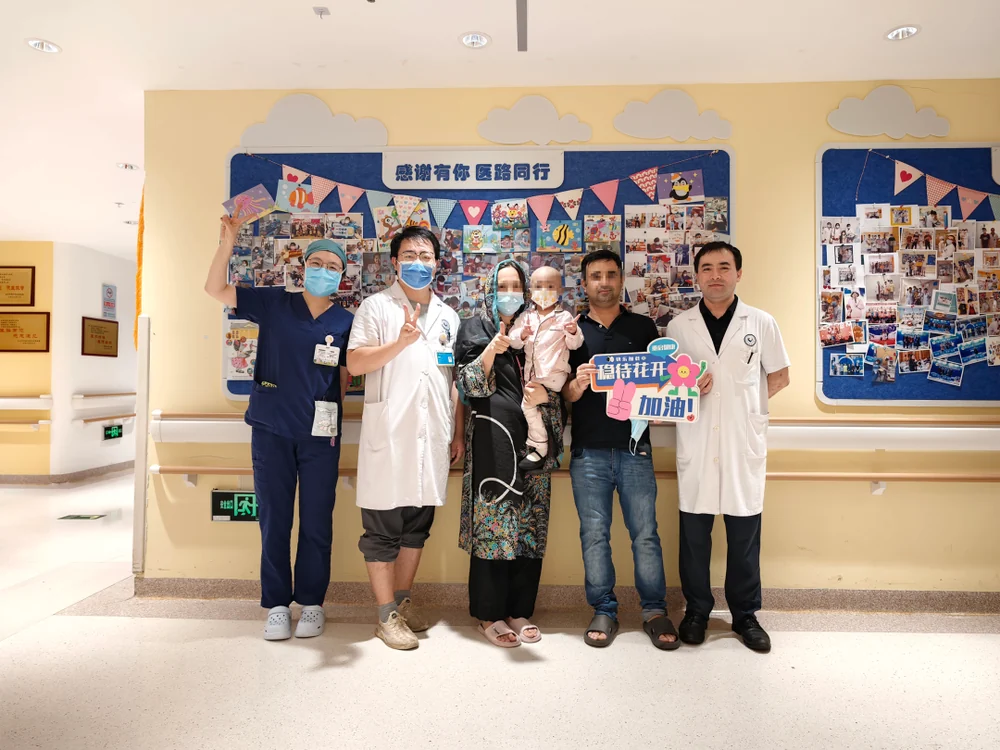
On the day of discharge — the happiness on every face in this family tells its own story
May this dancing Pakistani girl carry everyone's blessings home — and run freely, dance freely, and grow up freely in the sun.
And may every family seeking treatment in a foreign land meet a light, a group of people, and a tenderness willing to keep watch through the night for them.
Beta-thalassemia major is a lifelong transfusion dependency — unless the blood-forming system itself is replaced. For international families, three questions decide the path: whether a matched donor exists, whether a haploidentical transplant is feasible, and how quickly treatment can begin. At Beijing Jingdu Children's Hospital, a parent is almost always a viable donor, and assessment for a child arriving from abroad typically begins before travel, through remote review of records.
If your child is transfusion-dependent and no matched donor has been found, send us the diagnosis and HLA reports. We will tell you, honestly, what is possible.